
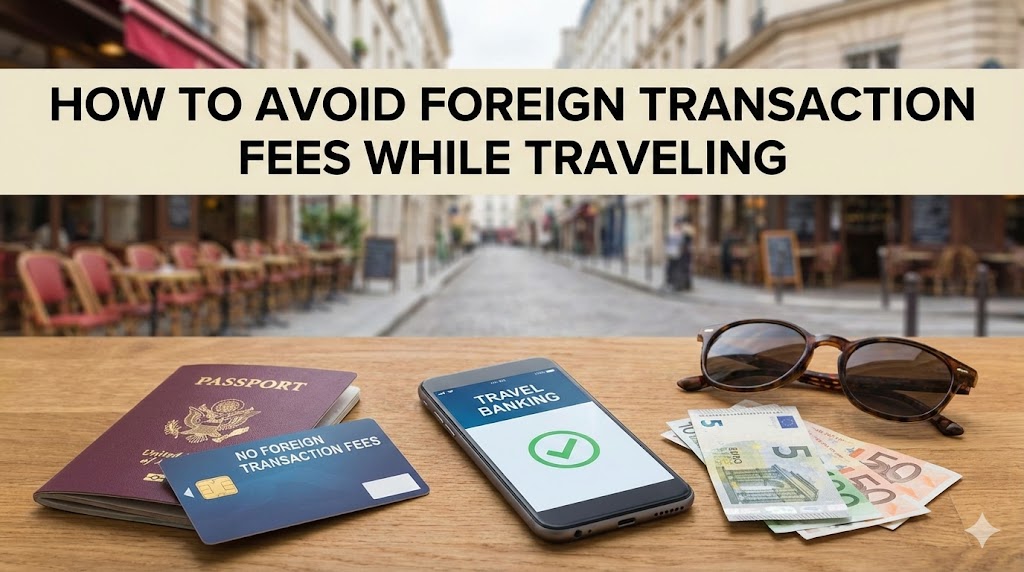
I learned this lesson the hard way in London a few years ago.
I checked my bank statement after a trip and saw a sea of small charges:
- Starbucks: $4.50 + $0.14 Fee
- Hotel: $200.00 + $6.00 Fee
- Train Ticket: $50.00 + $1.50 Fee
My bank was charging me a 3% “Foreign Transaction Fee” (FTF) on literally every single purchase. It felt like I was paying a hidden tax just for the privilege of accessing my own money.
In 2026, there is absolutely no reason to pay these fees. Here is my strategy for traveling internationally without giving the banks a single extra cent.
1. The “No FTF” Credit Card (The Basics)
Before you pack your bags, look at the credit cards in your wallet. If you are using a standard “cash back” card from a big bank, you are likely paying that 3% fee.
You need a card specifically marketed as “No Foreign Transaction Fees.”
- Travel Cards: Most cards with “Travel” or “Sapphire” or “Platinum” in the name have this built-in.
- The Test: Read the Terms & Conditions fine print. If you see “Foreign Transaction: None,” you are safe.
- My Rule: I put everything (hotels, flights, big meals) on this card to get the points without the penalty.
2. The “ATM Fee” Killer: Charles Schwab or Wise
Cash is still king in places like Japan or Germany. But ATMs are predatory. They charge you a fee to use the machine, and your bank charges you a fee to withdraw.
- The Heavy Hitter: The Charles Schwab Investor Checking debit card is legendary among travelers. Why? They reimburse ALL ATM fees worldwide at the end of the month. I once withdrew cash from a sketchy ATM in Thailand that charged me $8, and Schwab gave it back to me.
- The Modern Alternative: If you can’t open a Schwab account, use your Wise card (formerly TransferWise). You get a certain amount of free withdrawals per month, and the exchange rate is unbeatable.
3. The “Dynamic Currency Conversion” Scam (CRITICAL!) ⚠️
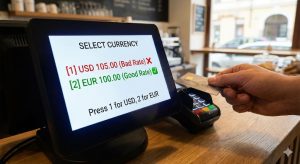
This is the most important paragraph in this article. Please read this twice.
When you pay for something in Europe or Asia, the card terminal might pop up with a friendly message:
“Would you like to pay in USD (Your Home Currency) or EUR (Local Currency)?”
It looks helpful. It shows you the exact amount in dollars. DO NOT CLICK USD.
This is a trap called Dynamic Currency Conversion (DCC).
- If you choose USD: The merchant’s bank decides the exchange rate. It is usually terrible (5% to 10% markup).
- If you choose Local Currency (EUR/JPY): Your bank decides the exchange rate. It will be much, much better.
The Rule: Always, always, ALWAYS choose to pay in the local currency of the country you are in. Let your bank handle the math.
4. Don’t Exchange Cash at the Airport
We’ve all seen those currency exchange booths at the airport with signs saying “Zero Commission!”
They are lying. Sure, they don’t charge a “fee,” but their exchange rate is awful. You might lose 15% of your money just on the bad rate.
Better Strategy: Land at the airport, walk past the exchange booth, find a legitimate bank ATM, and withdraw local cash using your Schwab or Wise card. You will get the fair market rate instantly.
Final Checklist Before You Fly
- Notify your bank: Open your banking app and set a “Travel Notice” so they don’t freeze your card when you buy a croissant in Paris.
- Bring two cards: Always have a backup. If your main card gets eaten by an ATM, you need a Plan B.
- Download offline maps: Okay, not a money tip, just a sanity tip.
Travel safe, and spend that 3% savings on another gelato instead of giving it to your bank!